

You’ve decided to upgrade your kitchen. Now comes the question that trips up nearly every homeowner at some point, do you go with custom cabinets or just grab stock cabinets from a home improvement store?
It’s not as simple as “spend more, get more.” The right choice depends on your kitchen layout, your budget, how long you plan to stay in the home, and honestly, how much the finished result matters to you day-to-day.
Both options have real advantages. Both have real trade-offs. And choosing the wrong one can mean either overspending on a rental property or underspending on a forever home you’ll eventually regret.
If you’re in the early stages of planning a kitchen remodel, the team at Alfa Wood Works can help you figure out which direction makes the most sense for your specific space and goals before you commit to anything.
Let’s break it all down.
What Are Stock Cabinets?
Stock cabinets are pre-manufactured in fixed sizes and stored in warehouses, ready to ship within days. You’ll find them at big-box retailers like Home Depot and IKEA, typically in a limited range of standard dimensions usually in 3-inch width increments, from 9 inches up to 48 inches wide.
They come in a handful of finishes and door styles. What you see on the shelf (or website) is largely what you get.
Pros of Stock Cabinets
- Fast availability often in stock and ready within 1–2 weeks
- Lower upfront cost typically $60–$200 per linear foot
- Easy to replace individual units can be swapped out if damaged
- Good for rental properties or quick flips serviceable and cost-effective
Cons of Stock Cabinets
- Standard sizes only gaps and fillers are often needed in non-standard kitchens
- Limited customization you choose from what’s available, not what you want
- Lower material quality most use particleboard boxes and thinner construction
- Shorter lifespan typically 10–15 years before wear becomes visible
- Generic look difficult to create a truly unique or high-end finish
What Are Custom Cabinets?
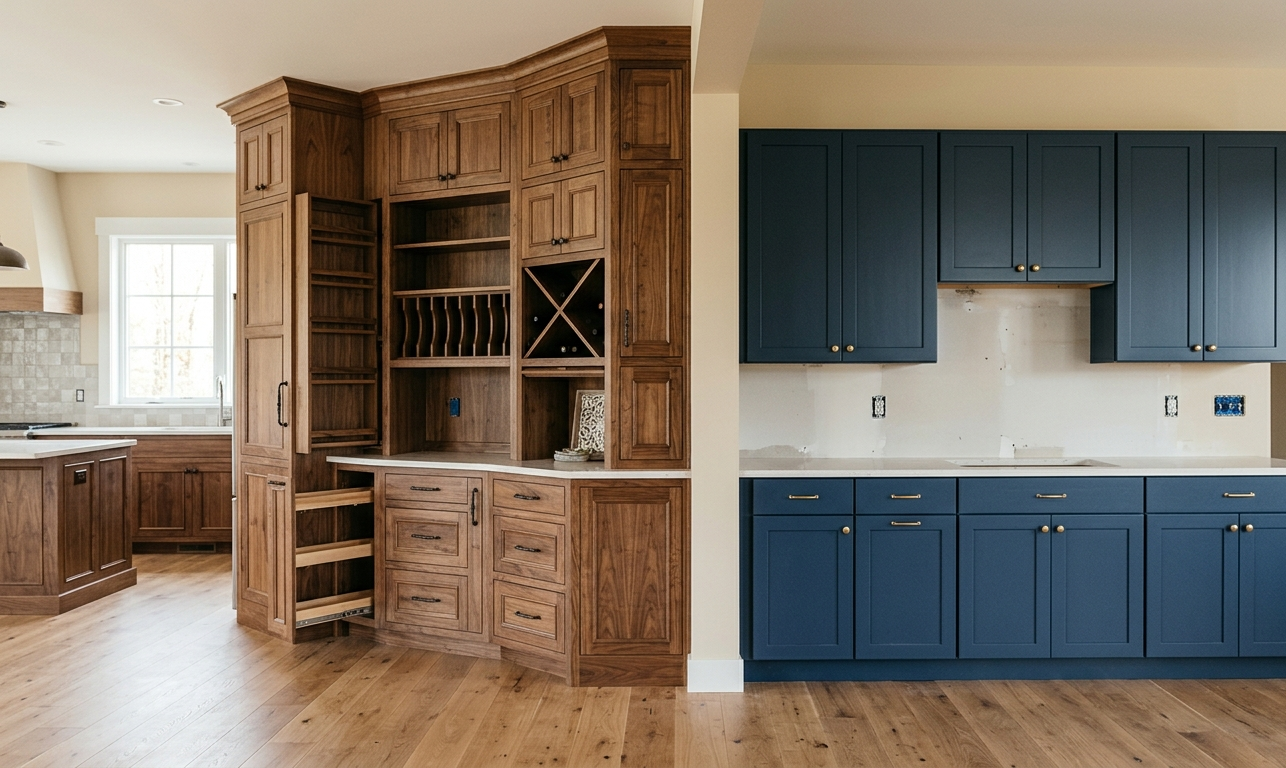
Custom cabinets are built from scratch, specifically for your kitchen. A cabinet maker designs them to fit your exact wall dimensions, ceiling height, and layout down to the quarter inch. You choose the wood species, box construction, door profile, finish color, and hardware.
Nothing is pre-made. Everything is purpose-built for your home.
Pros of Custom Cabinets
- Perfect fit no gaps, no fillers, no wasted space
- Unlimited design options any wood, any color, any door style
- Superior construction solid wood frames, plywood boxes, dovetail drawers
- Built-in storage solutions pull-outs, organizers, spice racks, and custom inserts
- Longer lifespan quality custom cabinets last 25–50 years with proper care
- Higher home value especially important in competitive real estate markets
Cons of Custom Cabinets
- Higher cost typically $500–$1,500 per linear foot installed
- Longer lead time 8–14 weeks from design approval to installation
- Requires a skilled cabinetmaker results depend heavily on who you hire
Custom Cabinets vs Stock Cabinets: Side-by-Side Comparison
| Feature | Stock Cabinets | Custom Cabinets |
| Price per linear foot | $60–$200 | $500–$1,500 |
| Lead time | 1–2 weeks | 8–14 weeks |
| Size options | Standard increments only | Any dimension |
| Material quality | Particleboard / MDF mix | Solid wood / plywood |
| Design flexibility | Very limited | Unlimited |
| Lifespan | 10–15 years | 25–50 years |
| Installation complexity | DIY-friendly | Requires professional |
| Resale value impact | Low to moderate | High |
| Best suited for | Rentals, flips, tight budgets | Primary homes, long-term stays |
The Cost Difference: Is Custom Worth the Price?
Let’s be direct custom cabinets cost significantly more upfront. A full kitchen with stock cabinets might run $8,000–$15,000 installed. The same kitchen with custom cabinets could cost $25,000–$50,000 or more depending on materials and complexity.
That’s a real gap. But here’s what the raw numbers don’t show:
Custom cabinets are a one-time purchase. Stock cabinets in a heavily used kitchen often need replacement or significant repair within 10–15 years. Custom cabinets, built with plywood boxes and solid wood construction, regularly last 30+ years without major issues.
When you factor in the cost of replacing stock cabinets once or twice over a 30-year period plus the labor involved each time the lifetime cost difference shrinks considerably.
And in California’s real estate market, kitchen quality is one of the first things buyers notice. A kitchen with custom cabinetry, quality hardware, and thoughtful design routinely returns 60–80% of its cost at resale, according to data from Remodeling Magazine’s Cost vs. Value reports.
What About Semi-Custom Cabinets?
Semi-custom cabinets sit between stock and fully custom. They use pre-built cabinet boxes but allow modifications in sizing, finish, and some interior features. They typically cost $150–$500 per linear foot.
Semi-custom is a solid middle-ground option for homeowners who want more flexibility than stock but aren’t ready to commit to a full custom build. They work well for:
- Kitchens with mostly standard dimensions
- Mid-range remodel budgets ($12,000–$25,000)
- Homeowners who plan to sell within 5–10 years
However, semi-custom still comes with limitations. You’re working within a manufacturer’s system, which means you won’t get truly unique sizing or fully bespoke design details.
Which Is Right for Your Situation?
Choose Stock Cabinets If:
- You’re remodeling a rental property or investment flip
- Your budget is under $12,000 for a full kitchen
- You need the kitchen functional within a few weeks
- Your kitchen has standard dimensions with no awkward corners or high ceilings
- You plan to sell the home within 2–3 years
Choose Custom Cabinets If:
- This is your primary home and you plan to stay for 10+ years
- Your kitchen has non-standard dimensions, angled walls, or unique architectural features
- You want a specific look a particular wood grain, paint color, or door profile you can’t find off the shelf
- You’re prioritizing long-term quality and durability over short-term savings
- You want built-in storage solutions that actually fit your lifestyle
- You’re in a competitive real estate market where kitchen quality drives buyer decisions
Choose Semi-Custom Cabinets If:
- You want more flexibility than stock but are working with a mid-range budget
- Your kitchen is mostly standard-sized with a few tricky spots
- You want a cleaner, more polished look without full custom pricing
Material Quality: What’s Actually Inside the Cabinet?
This is where stock cabinets often fall short, and it’s worth understanding before you decide.
Box construction is the hidden quality indicator most people overlook. The cabinet box — the structural carcass behind the door determines how long your cabinets last and how well they hold up to daily use.
- Stock cabinets typically use ¾-inch particleboard or low-density fiberboard for box construction. These materials are sensitive to moisture, swell over time, and don’t hold screws as firmly as plywood.
- Custom cabinets are built with ¾-inch plywood boxes as standard. Plywood is stronger, more moisture-resistant, and holds fasteners significantly better over time.
The difference becomes obvious 5–7 years in. Particleboard boxes near a dishwasher or under a sink show damage first. Plywood holds up.
Similarly, drawer construction tells a story:
- Stock drawers: typically stapled together with a simple track system
- Custom drawers: dovetail joinery, soft-close undermount slides, solid wood or plywood construction
If you open a drawer 5–10 times a day for 20 years, that construction difference adds up fast.
Installation: Stock vs Custom
Stock cabinet installation is relatively straightforward and is often done as a DIY project by experienced homeowners. Cabinets come in fixed sizes, and installation involves leveling, securing to studs, and adjusting doors.
Custom cabinet installation is a different process entirely. It requires precise measurements taken during the design phase, careful coordination between the fabrication shop and installer, and adjustments made on-site for walls that are never perfectly plumb or square. This is skilled labor, and it should be treated as such.
Hiring an inexperienced installer for custom cabinets is one of the most common and costly mistakes homeowners make. Always ask your cabinetmaker whether installation is included in the quote and who specifically will be doing the work.
How Kitchen Cabinets Affect Home Resale Value in California
California’s housing market is among the most competitive in the country. In cities like San Jose, Los Angeles, and San Francisco, buyers walk into a kitchen and form an impression within seconds.
Stock cabinets in a $900,000 home send the wrong message and buyers notice. Custom or high-quality semi-custom cabinetry, on the other hand, signals craftsmanship and care throughout the rest of the home.
Real estate professionals consistently rank kitchen remodels among the top three highest-return renovations. In the Bay Area specifically, a well-executed kitchen with custom cabinetry can add $30,000–$75,000 in perceived value depending on the neighborhood and buyer pool.
That doesn’t mean you need to max out your budget. But it does mean that choosing quality cabinets in a primary California home is rarely a financial mistake.
Conclusion
When it comes to custom cabinets vs stock cabinets, there’s no universal right answer but there is a right answer for your situation.
Stock cabinets make sense when speed and budget are the priority and the kitchen doesn’t need to impress. Custom cabinets are the clear choice when you want a kitchen that fits perfectly, lasts decades, and genuinely reflects the quality of your home.
For most California homeowners in a primary residence, the investment in custom cabinetry pays off in daily quality of life and at resale.
At Alfa Wood Works, we take the time to understand your space, your style, and your budget and we build cabinets that last. Reach out to our team to schedule a free consultation and get started on a kitchen you’ll love for years to come.
Frequently Asked Questions
What is the main difference between custom and stock cabinets?
Stock cabinets are pre-made in standard sizes with limited finish options. Custom cabinets are built specifically for your kitchen in any dimension, material, or design you choose. Custom cabinets offer better fit, higher quality construction, and significantly more design flexibility.
Are custom cabinets worth the extra cost?
For most primary homeowners especially in California, yes. Custom cabinets last 25–50 years, fit your kitchen perfectly, and increase resale value. Over a 30-year period, the cost difference between replacing stock cabinets twice versus maintaining custom cabinets once often narrows considerably.
How long do stock cabinets last compared to custom cabinets?
Stock cabinets typically last 10–15 years in a busy kitchen before showing significant wear. Quality custom cabinets, built with plywood boxes and solid wood construction, regularly last 30–50 years with basic maintenance.
Can you mix stock and custom cabinets in the same kitchen?
Yes, and some homeowners do this strategically using custom cabinets for high-visibility areas like the island and perimeter, and semi-custom or stock for less prominent utility spaces like a laundry room or garage. However, mixing finishes requires careful planning to keep the look cohesive.
What is the lead time for custom cabinets?
Most custom cabinet projects take 8 to 14 weeks from design approval to completed installation. Fabrication typically takes 6–10 weeks depending on the shop’s current workload. Planning 3–4 months ahead is recommended, especially during busy remodel seasons.
Do custom cabinets increase home value?
Yes. In competitive real estate markets like California, custom cabinetry is one of the most impactful kitchen investments. Quality kitchen remodels consistently return 60–80% of their cost at resale, and custom cabinets are a key driver of buyer perception and offer price.
What wood is best for custom kitchen cabinets?
The best wood depends on your design goals and budget. Maple is popular for painted finishes and offers great value. White oak is trending heavily in 2025–2026 for its clean, modern grain. Cherry and walnut are premium choices for rich, warm tones. A skilled cabinetmaker can help you choose the right species for your specific kitchen vision.