
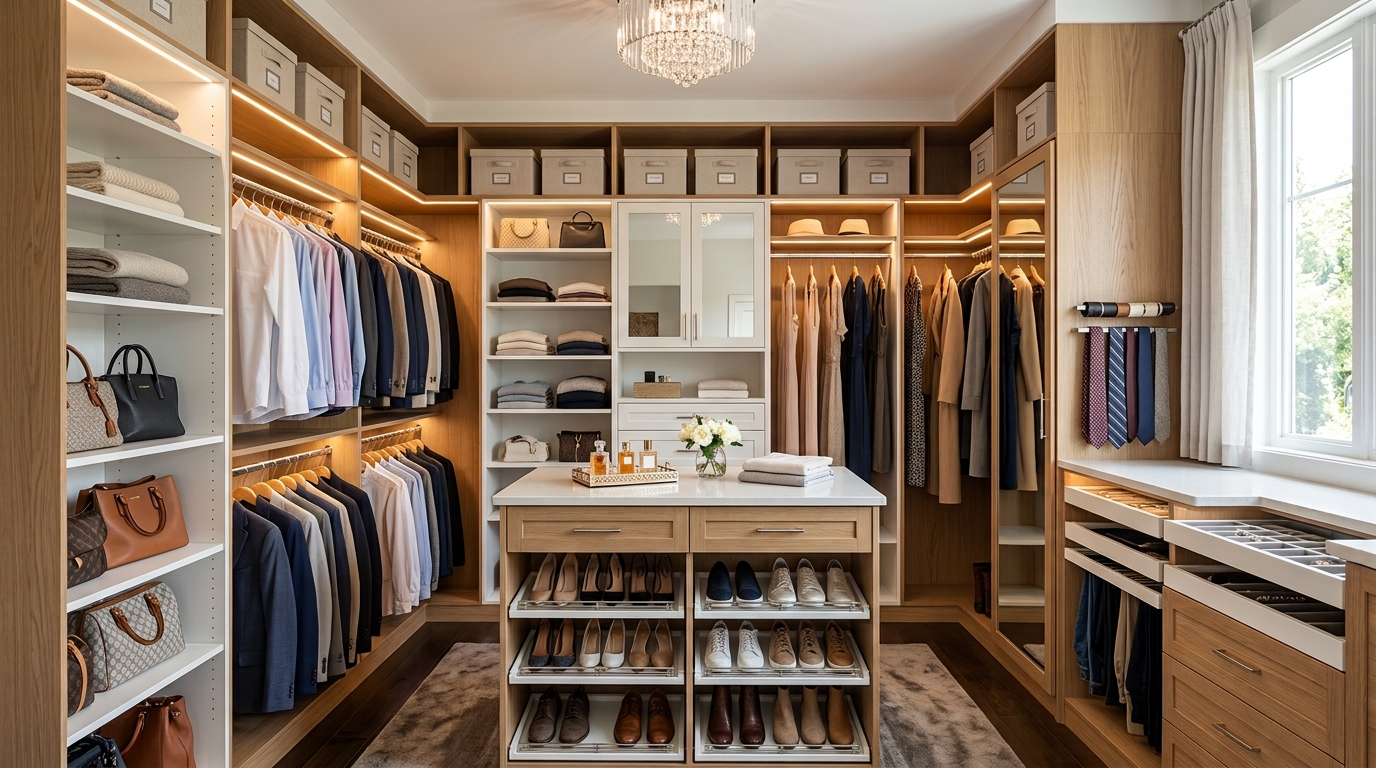

Most people don’t realize how much a well-designed closet can improve daily life until they finally get one. If you’ve ever struggled with a pile of clothes on the floor, tangled hangers, or shoes tumbling off a shelf, you already know how frustrating a poorly organized closet can be. The good news is that custom closet design doesn’t have to be complicated or outrageously expensive.
At Alfa Woodworks, we design and build custom closets for homeowners all across San Jose, Santa Clara, and the greater Bay Area. We’ve seen firsthand how the right storage system can completely change a morning routine, reduce clutter, and even make a bedroom feel more peaceful. In this guide, we’ll walk through the best custom closet design ideas for every type of space.
Why Custom Closets Outperform Standard Closet Systems
Before we dive into design ideas, it’s worth understanding why custom closets are worth the investment compared to off-the-shelf storage solutions.
Store-bought closet kits are built to standard dimensions. Your walls, ceilings, and floor space almost never match those dimensions exactly. The result is wasted space corners that go unused, shelves that are too high or too low, and hanging sections that don’t actually fit your wardrobe.
Custom closets are designed around your specific room measurements, your specific storage needs, and your personal lifestyle. A custom closet maker will visit your home, measure every inch of the space, and design a system that uses every available square foot intelligently.
Custom closets also use higher-quality materials than most off-the-shelf kits. That means they look better, hold up longer, and add real value to your home when it’s time to sell.
Types of Custom Closets: Which One Is Right for You?
Walk-In Closets
Walk-in closets are the gold standard of bedroom storage. If you have the floor space — typically at least 5×5 feet a walk-in closet offers the most flexibility. You can include full-length hanging sections, double hang rods for shorter items, built-in shoe shelves, accessory drawers, and even a center island for folding and display.
In Bay Area homes, walk-in closets often serve as a secondary dressing area. Adding proper lighting and a full-length mirror can make even a modest walk-in feel luxurious.
Popular walk-in configurations include:
- U-shaped layout: Uses three walls for maximum storage
- L-shaped layout: Works well in smaller rectangular spaces
- Parallel layout: Two opposing walls of shelving and hanging space with a central walkway
Reach-In Closets
Reach-in closets are the most common type found in Bay Area homes a shallow, single-rod closet behind a pair of sliding or bi-fold doors. Most standard reach-in closets are dramatically underutilized.
A custom reach-in design can transform this space by:
- Adding double-hang rods to double the hanging capacity
- Installing adjustable shelves at multiple heights
- Adding drawers or bins at the bottom for folded items
- Using the full height of the closet with high shelving for seasonal storage
Wardrobe Closets
If your bedroom doesn’t have a built-in closet at all, a custom built-in wardrobe is an elegant solution. Built-in wardrobes look like they were always part of the room, and they can be designed with any combination of hanging space, drawers, and shelving.
Kids’ Closets
Children’s closets have unique requirements. Kids are shorter, their clothes are smaller, and their storage needs change quickly as they grow. A custom kids’ closet should use lower double-hang rods for current clothes, include plenty of bin storage for toys and accessories, and use adjustable shelving so the system can grow with the child.
Must-Have Custom Closet Features
No matter what type of closet you’re designing, these features will make the biggest difference in how organized and functional the space feels:
Adjustable shelving: Fixed shelves quickly become a problem as your storage needs change. Adjustable shelves let you reconfigure the space over time without a carpenter.
Pull-out shoe racks: Standard shoe shelves are fine, but angled pull-out racks display shoes beautifully and make it easy to find the pair you need.
Velvet-lined jewelry drawers: Small, dedicated drawers for jewelry keep necklaces from tangling and rings from getting lost.
Belt and tie racks: Dedicated hardware for belts and ties keeps accessories visible and accessible.
Built-in lighting: Closet lighting is often overlooked, but it makes a huge difference. LED strip lighting inside the closet illuminates every corner and makes getting dressed in the dark much easier.
Valet rod: A pull-out rod for laying out tomorrow’s outfit or staging dry cleaning is a small feature that has a big impact on daily routine.
Custom Closet Materials: What to Choose
The material you choose for your closet determines both how it looks and how long it lasts.
Melamine-coated particleboard is the most common material for closet systems. It’s affordable, comes in a wide range of finishes, and is easy to clean. However, it’s not as strong as solid wood for heavy items.
Plywood is stronger than particleboard and holds screws better. It’s a good choice for drawer boxes and shelves that will bear heavy weight.
Solid wood is the premium choice. It’s durable, beautiful, and can be stained or painted to match any aesthetic. Solid wood closets are more expensive but are a genuine long-term investment.
Painted MDF offers a smooth, paintable surface that’s ideal for a clean, high-end look. It’s a popular choice for modern closets in Bay Area homes.
According to a report by the National Association of Realtors, closet organization systems are one of the home improvement features that buyers value most, often returning a significant portion of the investment at resale.
Closet Design Tips for Small Spaces
Not every Bay Area home has a spacious master suite. If you’re working with limited closet space, here’s how to make the most of it:
- Go vertical. Use the full height of the wall, even if it means using a step stool to reach the top shelf. High shelves are perfect for seasonal items.
- Use the back of the door. Over-door organizers for shoes, accessories, or cleaning supplies are a great way to add storage without taking up floor space.
- Double your hanging capacity. Anywhere you have clothes that are shorter than 40 inches blouses, folded pants, jackets you can add a second hanging rod below.
- Choose light colors. Light-colored closet interiors make small spaces feel larger and brighter.
Conclusion
A custom closet is one of the most practical upgrades you can make to your home. It reduces morning stress, keeps your belongings organized, and makes every square foot of your space work harder. Whether you’re redesigning a walk-in master closet or trying to squeeze more storage out of a small reach-in, the key is working with a team that understands your specific needs.
Alfa Woodworks designs and builds custom closets for San Jose and Bay Area homeowners who want storage that’s as beautiful as it is functional. Reach out to our team today for a free design consultation.
Frequently Asked Questions
Q: How much does a custom closet cost in San Jose?
Custom closet costs vary widely depending on size, materials, and features. A basic custom reach-in closet might start around $1,500, while a full walk-in master closet with premium finishes can range from $5,000 to $15,000 or more.
Q: How long does it take to install a custom closet?
Most custom closet installations take one to two days once the materials are fabricated. The design and fabrication process typically takes two to four weeks from the initial consultation.
Q: Can I add a custom closet to a room without an existing closet?
Yes. Built-in wardrobe systems can be added to any room. Your cabinet maker will design the system to fit the available wall space and ceiling height.
Q: What is the most durable material for custom closets?
Plywood and solid wood are the most durable options. For a balance of durability and affordability, ¾-inch plywood with a painted or laminate finish is an excellent choice.
Q: Do custom closets increase home value?
Yes. Well-designed custom closets are consistently listed as a feature that appeals strongly to home buyers, and they can increase the perceived value and marketability of your home.