

Deep kitchen cabinets should be a storage blessing. In reality, for most homeowners, they become the black hole of the kitchen, a place where pots, pans, baking sheets, and appliances disappear into the back, never to be found again until you’re already frustrated and late for dinner.
If you’ve been dealing with the frustration of poorly organized deep cabinets, you’re not alone. It’s one of the most common complaints we hear from homeowners in San Jose and the Bay Area. At Alfa Woodworks, we build custom cabinet systems with smart storage solutions built right in but even if you’re not ready for a full cabinet remodel, there’s a lot you can do to make your existing deep cabinets work better.
Why Deep Cabinets Are So Frustrating
The problem with deep cabinets especially base cabinets that are 24 inches deep is that the back half is essentially inaccessible. You end up stacking items in front of other items, and every time you need something in the back, you have to unload the front first.
This is a design problem, not an organization problem. The solution isn’t just rearranging what’s in the cabinet, it’s changing how the cabinet functions.
The Best Organization Solutions for Deep Kitchen Cabinets
1. Pull-Out Shelves and Drawer Inserts
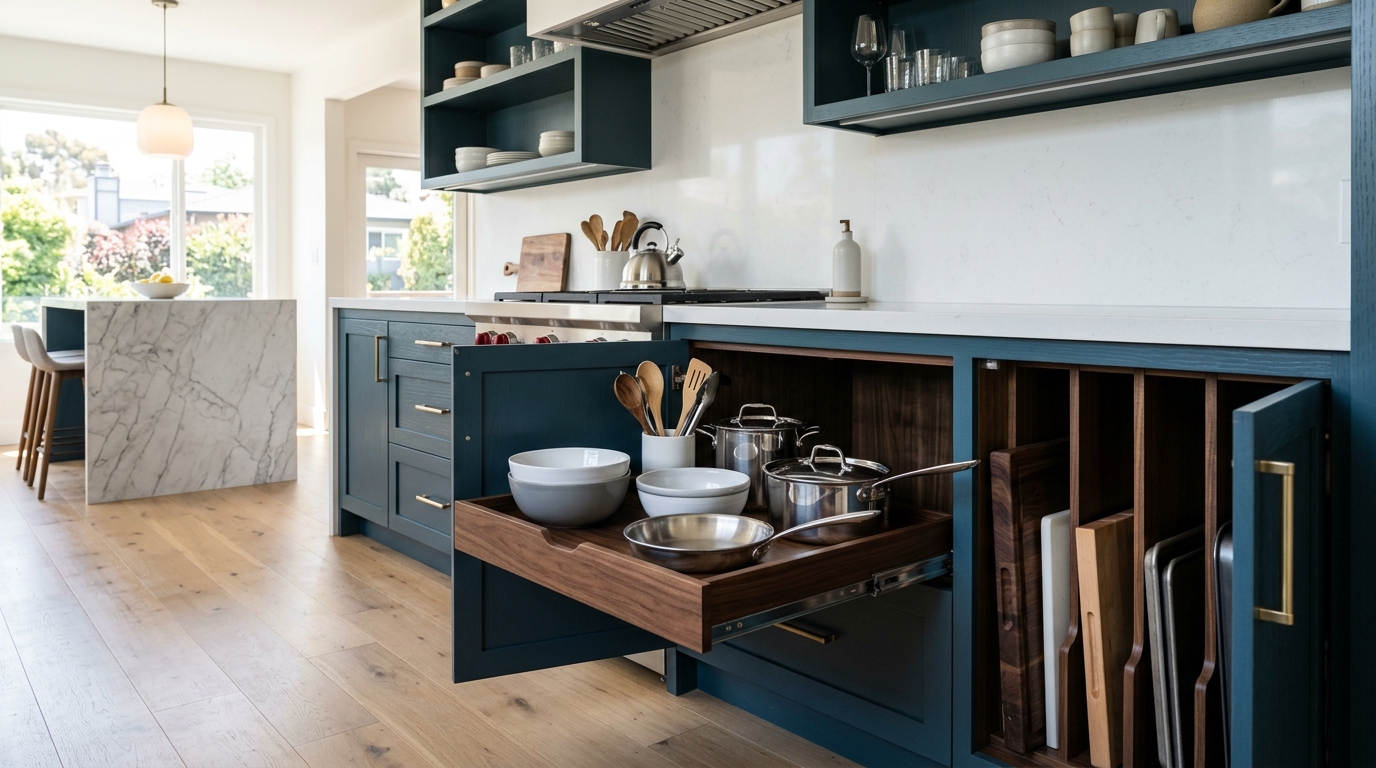
Pull-out shelves are the single best upgrade you can make to a deep cabinet. They convert the full depth of the cabinet into usable, accessible space. Instead of reaching into the back of a dark cabinet, you simply pull the shelf out to you, everything is visible, and everything is within reach.
Pull-out shelves work in base cabinets under the counter and in pantry cabinets. They can be retrofitted into existing cabinets or built into new custom cabinetry from the start.
Best for: Pots and pans, small appliances, canned goods, baking supplies
2. Lazy Susans and Corner Carousel Systems
Corner base cabinets are some of the deepest and hardest to access in any kitchen. A well-designed lazy Susan, a rotating carousel that brings the back of the corner cabinet forward solves this problem elegantly.
Full-circle lazy Susans work in true corner cabinets. Kidney-shaped (D-shaped) lazy Susans work better in blind corner cabinets where the opening is offset. Magic corner systems, which pull out and swing the back shelves forward, are the most functional option for blind corners.
Best for: Corner base cabinets, corner pantry cabinets
3. Deep Drawer Systems
If you’re planning a new kitchen, seriously consider replacing some of your deep base cabinet shelves with deep drawers. Base cabinet drawers, especially three-drawer configurations, provide far better access to pots, pans, and heavy items than a cabinet with a door.
You can see everything at once, you can access items without bending over as far, and you don’t have to lift things over each other to get to what you need. Many professional cooks prefer an all-drawer base cabinet configuration for exactly these reasons.
Best for: Pots, pans, lids, mixing bowls, kitchen tools
4. Vertical Dividers for Sheet Pans and Cutting Boards
Baking sheets, cutting boards, sheet pans, and wire racks are the items most likely to create an avalanche when you’re trying to get one out of a stack. Vertical dividers, either custom-built into the cabinet or installed as aftermarket organizers, store these items upright, making each one individually accessible.
A vertical divider section works best in a base cabinet near the oven. It’s a small change that makes a huge difference in daily kitchen use.
Best for: Baking sheets, cutting boards, cooling racks, lids
5. Under-Shelf Baskets and Bin Systems
For deep upper cabinets, under-shelf baskets are a simple and inexpensive way to use the vertical space between shelves. They hang from the shelf above and create a second storage tier below.
Stackable bins and containers with clear sides also make deep cabinets more functional. When you can see what’s inside without having to move anything, the back of the cabinet becomes usable again.
Best for: Canned goods, dry goods, snacks, spices, small jars
6. Appliance Garages
If you have deep upper or base cabinets near the counter, consider converting one into an appliance garage, a cabinet designed specifically to store small appliances (toaster, coffee maker, food processor) while keeping the counter clear. A roll-up or pocket door makes it easy to access the appliances while hiding them completely when not in use.
Best for: Small appliances, coffee stations, blender storage
How Custom Cabinets Solve Deep Storage Problems from the Start
The smartest approach to deep cabinet organization is to address it during the design process rather than after installation. When you work with a custom cabinet maker, you can specify pull-out shelves, drawer inserts, built-in dividers, and lazy Susans as part of the original cabinet design.
This means you get storage that’s perfectly sized for your specific items, integrated seamlessly into the cabinet structure, and built with the right hardware to function smoothly for years.
At Alfa Woodworks, we design kitchen cabinets with storage functionality at the forefront. We ask every client detailed questions about what they store, how they cook, and how they use their kitchen, and then we design a cabinet system that puts everything within easy reach.
According to a survey by the National Kitchen & Bath Association, homeowners consistently rank storage and organization as their top motivator for kitchen remodeling, outranking aesthetics in many cases.
Zone Your Kitchen Storage
Even with the best cabinet organization tools, storage only works if the right items are in the right place. The concept of kitchen zones, grouping items by where and how you use them, dramatically improves kitchen efficiency.
- Cooking zone (near the stove and oven): Pots, pans, baking sheets, cooking utensils, spices, oils
- Prep zone (near the main counter): Cutting boards, mixing bowls, food processor, knives
- Coffee and beverage zone (near the coffee maker): Coffee, tea, mugs, glasses
- Pantry zone (away from the main work area): Dry goods, canned goods, snacks, baking supplies
- Cleaning zone (near the sink and dishwasher): Dish soap, sponges, cleaning supplies, towels
When your storage zones align with your workflow zones, your kitchen becomes dramatically more functional even without adding a single new cabinet.
Conclusion
Deep kitchen cabinets don’t have to be a source of frustration. With the right combination of organization tools, pull-out shelves, drawer systems, lazy Susans, and smart zoning, you can transform your kitchen into a space where everything has a home and everything is easy to find.
If you’re ready for a kitchen cabinet solution that addresses deep storage from the ground up, Alfa Woodworks is here to help. Our custom cabinet designs build functionality right into the structure from day one. Feel free to contact us to get started on your project.
Frequently Asked Questions
Q1: What is the best organizer for deep kitchen cabinets?
Pull-out shelves are the single most effective solution for deep kitchen base cabinets. They make the full depth of the cabinet accessible without having to move items out of the way.
Q2: How do I organize a deep corner cabinet?
A lazy Susan or magic corner pull-out system is the most effective way to organize a deep corner cabinet. Magic corner systems pull out and swing the rear shelves forward, giving full access to items in the back.
Q3: Can I add pull-out shelves to existing cabinets?
Yes. Pull-out shelf kits are available for retrofitting into existing cabinets. However, for a more precise fit and higher quality result, a custom cabinet maker can build pull-outs to the exact dimensions of your cabinets.
Q4: Should I use deep or shallow base cabinets in a kitchen?
Standard base cabinets are 24 inches deep. Shallower cabinets (12, 18 inches) are sometimes used for specific applications like pantry pull-outs or narrow galley kitchens. For most kitchen applications, 24-inch-deep base cabinets with pull-out shelves offer the best storage capacity.
Q5: How do I keep a deep pantry cabinet organized?
Use pull-out shelves at different heights, group items by category (baking, snacks, canned goods), and use clear bins so you can see contents at a glance. A step-shelf riser in the back of the cabinet can also make shorter items visible behind taller ones.