
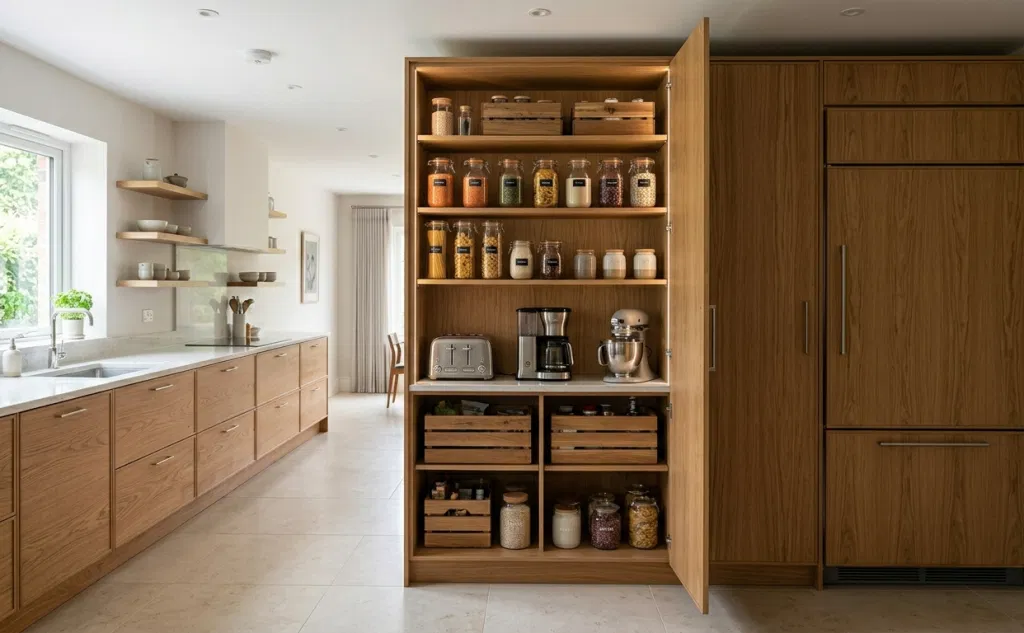

Good pantry organization comes down to visible storage at the right depth, clear zones for different food types, and shelves sized for what you actually store. If cans disappear behind cereal boxes and groceries keep expiring unopened, standard shelving may not fit your kitchen, or your routine.
A well-planned pantry makes it easier to see what you have, put groceries away, and use older items first. You don’t need a large walk-in room to get there. A tall cabinet with the right shelves and pull-outs can make a compact kitchen work much better.
Choose a pantry layout that fits your kitchen
Before choosing containers or shelves, look at the space you have and how you use it. These walk in pantry ideas and alternatives can help you compare options:
- Reach-in pantry with roll-outs: Keeps storage behind doors while bringing deep shelves forward. A good option when you have a closet or cabinet opening but limited room to step inside.
- Walk-in pantry with perimeter shelving: Works in a dedicated room where there’s enough clearance to move comfortably and reach shelves without blocking the entry.
- Tall cabinet pantry wall: Combines full-height storage with the rest of the kitchen cabinetry. It can be a practical choice in smaller San Jose or Santa Clara kitchens.
- Pull-out pantry next to the fridge: Makes a narrow gap useful for cans, jars, or packaged foods. Check door swing and access before committing to a very narrow unit.
- Butler’s pantry or pantry closet conversion: Can provide extra storage or a small prep area, but changes to walls, electrical, or plumbing may require permits. Confirm local requirements before work begins.
- Corner storage: Use a purpose-built corner solution or reserve the hard-to-reach area for infrequently used items.
For a compact galley kitchen, a tall cabinet or a narrow pull-out may add useful storage without taking up floor space. In a larger home, a walk-in pantry can also hold small appliances and a landing counter. The best choice is the one that makes everyday items easy to reach.

Pantry organization starts with clear zones
A pantry is easier to maintain when each group of items has a home. Grouping by category, and by how often you reach for it, helps prevent duplicate purchases and forgotten food.
- Daily snacks: Eye level, where family members can reach them.
- Breakfast foods and everyday staples: Near the center, grouped together.
- Baking supplies: Together on one shelf or in a dedicated bin, so flour, sugar, and extracts are easy to find.
- Cans and jars: Kept in a single row when possible, with labels facing forward.
- Bulk goods and small appliances: On upper shelves if they’re light and used occasionally; on lower pull-outs if they’re heavy.
- Pet food: Low to the floor in a sealed container or pull-out bin.
- Backstock: Extra packages behind or below the everyday supply, with older items moved to the front.
Keep categories simple enough to follow. A few labeled bins can help corral packets or snacks, but too many small containers can make restocking harder. Choose containers that fit the shelf and let you see what’s inside.
Set shelf depth and spacing for what you store
Shelf size can make or break kitchen pantry storage. Standard shelves are often 12–16 inches deep, while pull-outs can extend 20–24 inches. Deep fixed shelves may hold more in theory, but items at the back can be hard to see and reach. If you need deeper storage, a pull-out drawer or tray brings the contents forward.
Use these as starting points, then adjust for the items in your home:
- Cans and small jars: About 6–8 inches of vertical clearance.
- Everyday dry goods: Roughly 10–12 inches.
- Cereal boxes and taller canisters: Around 14–16 inches.
- Bulk packages or small appliances: About 16–18 inches or more, depending on the item.
- Counter-height landing zone: A work surface around 36 inches high can give you a place to set down groceries or use a small appliance. Leave about 16–18 inches above it for access and clearance.
Measure your tallest cereal box, largest canister, and appliances before fixing shelf heights. Adjustable shelves help accommodate changes later. For more ways to build storage into a kitchen, see our custom kitchen cabinets in San Jose page.

Compare pantry storage options
These broad ballparks are for planning, not quotes. Actual costs vary by size, materials, hardware, finish, and installation.
| Option | Visibility | Capacity | Adjustability | Cost ballpark | Best for |
|---|---|---|---|---|---|
| Fixed wire shelves | Fair; small items can tip or fall through | Moderate | Low | A few hundred dollars for basic organizers or upgrades | A simple refresh on a tight budget |
| Adjustable wood shelves | Good with suitable depth and spacing | Moderate to high | High | About $1,000–$3,000 for a shelving project | Flexible storage without a full built-in |
| Pull-out organizers | Very good; contents come forward | Good | Moderate | About $1,000–$3,000, depending on quantity and installation | Deep cabinets and hard-to-reach shelves |
| Full custom pantry built-ins | Very good when designed around your inventory | High for the available space | High | About $3,000–$10,000+ | A fitted pantry wall or larger custom project |
For ballpark budgeting, DIY organizers may cost a few hundred dollars, semi-custom shelving may run around $1,000–$3,000, and full custom pantry built-ins may start around $3,000 and reach $10,000 or more. These are broad Bay Area estimates, not fixed prices. Final pricing depends on a site visit and the project scope.
Add the details that help the system last
The right accessories make storage easier to use, but each one should solve a real problem. Consider:
- Pull-out drawers for deep lower shelves, heavy items, or cans that would otherwise get lost.
- Door-mounted racks for spices, wraps, or small packets, after checking that the door closes without hitting shelf contents.
- LED motion-sensor lighting to brighten corners and make labels easier to read.
- Labeled bins for loose packets, snacks, and baking supplies.
- Soft-close hardware for quieter, smoother drawers and doors.
- Ventilated shelves or baskets for produce that needs air circulation; avoid sealing these items in airtight containers.
A few common design mistakes are easy to prevent: shelves that are too deep, no lighting, fixed spacing that won’t fit cereal boxes, and no landing counter when there’s room for one. Wire shelves may let small items tip or slide, while a pantry with no restocking routine can fill with duplicates and expired food. Keep a simple habit: move older items forward when new groceries come in.
A Bay Area plan that makes use of every inch
Many San Jose and Bay Area homes have compact mid-century layouts, including Eichler-era homes and small galley kitchens. In these spaces, a tall pantry cabinet wall or a slim pull-out beside the refrigerator may be more practical than trying to add a walk-in pantry. ADUs and townhomes can also benefit from vertical storage, provided frequently used items stay within comfortable reach.
At Alfa Woodworks, we start by looking at what you store and how the room is laid out, then plan shelves and pull-outs around those needs. Our team builds cabinetry in-house from real wood and quality plywood, shares 3D renderings before the build, and provides professional local installation. Soft-close hardware is standard, and we send project photo updates and leave the job site clean. You can learn more about our work as a custom cabinet maker. For ideas in another hardworking room, see our guide to laundry room cabinets.
Frequently asked questions
What is the best shelving depth for a pantry?
For most everyday food, 12–16 inches is a useful range. Use deeper shelves selectively, and consider pull-outs for shelves around 20–24 inches deep so items at the back remain accessible.
How do I organize a deep pantry?
Group food by category, keep only one or two rows front-to-back, and move older items forward during restocking. Full-extension pull-outs or bins that can be pulled out are helpful when fixed shelves are deep.
Are pull-out shelves worth it?
They can be, especially for deep lower shelves, heavy goods, or cans that are hard to reach. For shallow shelves and lightweight items, adjustable fixed shelving may be simpler and less expensive.
How much does a custom pantry cost?
As a broad Bay Area estimate, custom pantry built-ins may range from about $3,000 to $10,000 or more. Size, materials, finish, hardware, and installation all affect cost, so a site visit is needed for a project-specific price.
What’s the ideal pantry shelf spacing?
It depends on what goes on each shelf. As a starting point, allow about 6–8 inches for cans, 14–16 inches for cereal boxes, and 16–18 inches for many bulk goods or small appliances. Measure your own items before setting fixed shelves.
Can you turn a closet into a pantry?
Often, yes. A closet can be fitted with adjustable shelves, drawers, or a landing surface. First check the opening, door swing, lighting, and any electrical or plumbing work; changes to the space may require permits.
If your pantry keeps collecting forgotten cans and duplicate groceries, a layout designed around your kitchen and daily routine can help. Alfa Woodworks offers a free consultation and 3D renderings before the build. Call (408) 818-9500 to talk through a pantry project in San Jose, Santa Clara, or the broader Bay Area.