
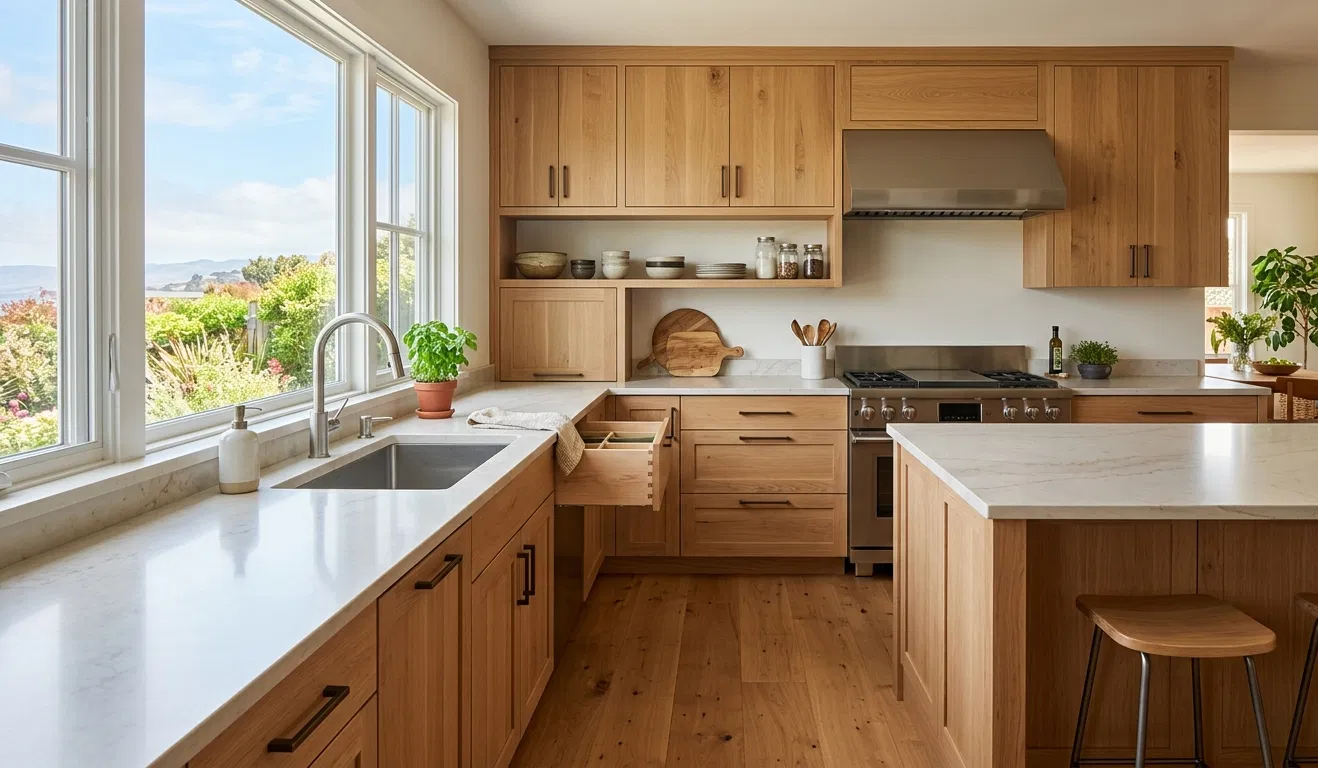

Custom cabinets cost more upfront but can fit your kitchen precisely, offer more choice in materials and design, and make better use of unusual spaces. Stock cabinets are usually the better choice when speed and budget matter most and your kitchen has standard dimensions. In the custom cabinets vs big box store cabinets decision, your room, timeline, and plans for the home matter as much as the price.
Custom cabinets vs prefab: what is the difference?
Stock or prefab cabinets come in set sizes and a limited selection of styles. They are commonly available quickly, but a kitchen that doesn’t match those standard dimensions may need fillers or adjustments.
Semi-custom cabinets start with standard product lines but offer more options, such as additional sizes, finishes, door styles, or modifications. Fully custom cabinets are designed and built around your measurements, layout, and chosen details.
Here’s a practical comparison. Prices are ballpark Bay Area estimates for a typical kitchen’s cabinets and straightforward installation, not a full remodel. Your final cost depends on measurements, materials, design, site conditions, and what installation includes.
| Stock | Semi-custom | Fully custom | |
|---|---|---|---|
| Fit to your space | Standard sizes; gaps may need fillers | More sizes and some adjustments | Made to the room’s measurements |
| Materials | Varies; often engineered-wood boxes and laminate finishes | Varies; plywood options may be available | Choose box, door, and finish materials for the project |
| Style options | More limited | Wider selection of finishes and doors | Broad choice of sizes, styles, and details |
| Durability | Depends on construction and care | Depends on product line and materials | Depends on materials, construction, finish, and installation |
| Lead time | Often fastest if in stock | Usually longer than stock | Usually the longest; confirm the maker’s schedule |
| Cost ballpark | About $3,000–$8,000 | About $8,000–$20,000 | About $15,000–$40,000+ |
| Best for | Standard layouts, tight budgets, quick schedules | A balance of flexibility and cost | Unusual layouts, specific designs, or exact-fit storage |
These ranges are estimates, not a quote. Confirm whether an estimate includes delivery, fillers, finished panels, hardware, installation, and any work needed to prepare or level the room. Countertops, demolition, plumbing, electrical work, and permits are generally separate.
When are stock cabinets the smarter choice?
Stock cabinets can be a sensible solution. They generally cost less and can be ready sooner, particularly when the needed sizes are available. If your kitchen has square walls, standard ceiling heights, and a straightforward layout, custom work may not add enough value to justify the extra cost.
Stock may be the right fit if you:
- Need to keep the cabinet budget low.
- Are updating a rental or preparing a property for sale.
- Want to complete a simple project on a short schedule.
- Have a standard layout and are comfortable with the available sizes and finishes.
Check the specifications before buying. Ask what the cabinet boxes, backs, doors, drawers, and hinges are made of. Product quality varies, even within the same category, so “stock” alone doesn’t tell you how a cabinet is built. Also make sure you understand whether the price includes installation or only the cabinets.

When does custom cabinetry pay off in a Bay Area kitchen?
Custom is most useful when standard dimensions create problems or when you have a specific use in mind. Some compact mid-century kitchens, including homes from the Eichler era, have tight layouts or details that make off-the-shelf sizing awkward. Older homes can also have walls that aren’t square, while tall ceilings may leave unused space above standard cabinets.
A custom plan can also help when you’re working with:
- ADUs or compact kitchens, where every inch of storage counts.
- Uneven walls, unusual corners, or non-standard appliance openings.
- Tall ceilings that call for cabinets designed to reach higher.
- Special requirements, such as a built-in Pooja mandir or storage for a specific routine.
- Commercial spaces that need cabinets to fit equipment, work surfaces, or a particular floor plan.
The value is not simply having a different door style. A good layout can reduce awkward gaps, add useful storage, and fit the way your household cooks. For ideas on planning storage, see our guide to organizing deep kitchen cabinets or laundry room cabinets.
Which materials and hardware should I compare?
The labels “stock,” “semi-custom,” and “custom” don’t guarantee a particular level of quality. Compare the actual construction. A plywood cabinet box is made from layers of wood veneer bonded together; particleboard is made from wood particles and resin. Both can serve a purpose, but particleboard is more vulnerable to swelling if water gets into an unsealed edge. Plywood generally holds screws well and can be a durable choice when properly built and installed.
Doors also vary. Real-wood doors show natural grain and can be stained. MDF doors provide a smooth surface for paint; their edges need a sound finish and protection from repeated moisture. Thermofoil is a vinyl film applied over a core, not a wood surface. Ask what the door is made of rather than relying on appearance alone.
Hardware is another point to check. Soft-close hinges and drawer slides may be standard in one line and an upgrade in another. At Alfa Woodworks, soft-close hardware is standard on our custom cabinetry. Ask for the specific hinge and slide details, along with samples or material specifications, before comparing bids.

How should I choose between stock, semi-custom, and fully custom?
Start with your room and priorities, not the cabinet label. Measure the walls, appliances, ceiling height, and door swings. Make a list of storage needs and note any plumbing, electrical, or ventilation details that could affect the layout.
Then compare estimates based on the same plan. Include the cabinet construction, finish, hardware, panels, fillers, installation, and lead time. A low starting price may not include the parts or labor needed to finish the job.
What we’d do: For a conventional kitchen with standard dimensions and a tight budget, we’d look seriously at stock or semi-custom. For a compact or irregular Bay Area kitchen, or a home where the layout needs to work for years, we’d first see what a custom design can solve. A site visit is the best way to determine whether the added fit and flexibility justify the higher estimate.
Alfa Woodworks LLC makes custom cabinetry for homeowners in San Jose, Santa Clara, and across the greater Bay Area. Our process includes 3D renderings before the build, in-house manufacturing, and professional installation. We also share project photos and updates so you can follow the work.
Frequently asked questions
Are custom cabinets worth the money?
They can be worth the added cost when standard cabinets leave wasted space, don’t suit the layout, or can’t provide the storage or style you need. For a standard kitchen where budget and speed are the main goals, stock cabinets may be a better fit.
Why are custom cabinets so expensive?
Custom cabinets involve design work, exact measurements, material selection, fabrication, finishing, and installation for a specific room. The final price also depends on cabinet size, wood and finish choices, hardware, storage features, and site conditions.
How long do custom cabinets last compared with stock cabinets?
There isn’t one lifespan for either category. Materials, construction, installation, moisture exposure, and everyday care all matter. Ask for the product specifications and warranty, and pay attention to protection around sinks and other areas where leaks can occur.
What are semi-custom cabinets?
Semi-custom cabinets are based on standard cabinet lines but offer more choices than stock, such as additional finishes, sizes, or modifications. Options and lead times vary by manufacturer.
Can I mix custom and stock cabinets?
Yes. Some homeowners use stock cabinets for standard runs and custom pieces where the room needs a precise fit, a special finish, or a built-in feature. The design and finish need to be coordinated so the different pieces work together.
How much value do custom cabinets add to a home?
There’s no fixed amount that custom cabinets add to resale value. Their practical benefit is a kitchen tailored to the home and the people using it. Whether that makes sense financially depends on your budget, the rest of the remodel, and how long you plan to stay.
If you’re weighing custom cabinets vs big box store cabinets for your kitchen, Alfa Woodworks can help you compare the options for your space. Explore our custom kitchen cabinets or learn more about working with a local cabinet maker. Book a free consultation or call (408) 818-9500.