
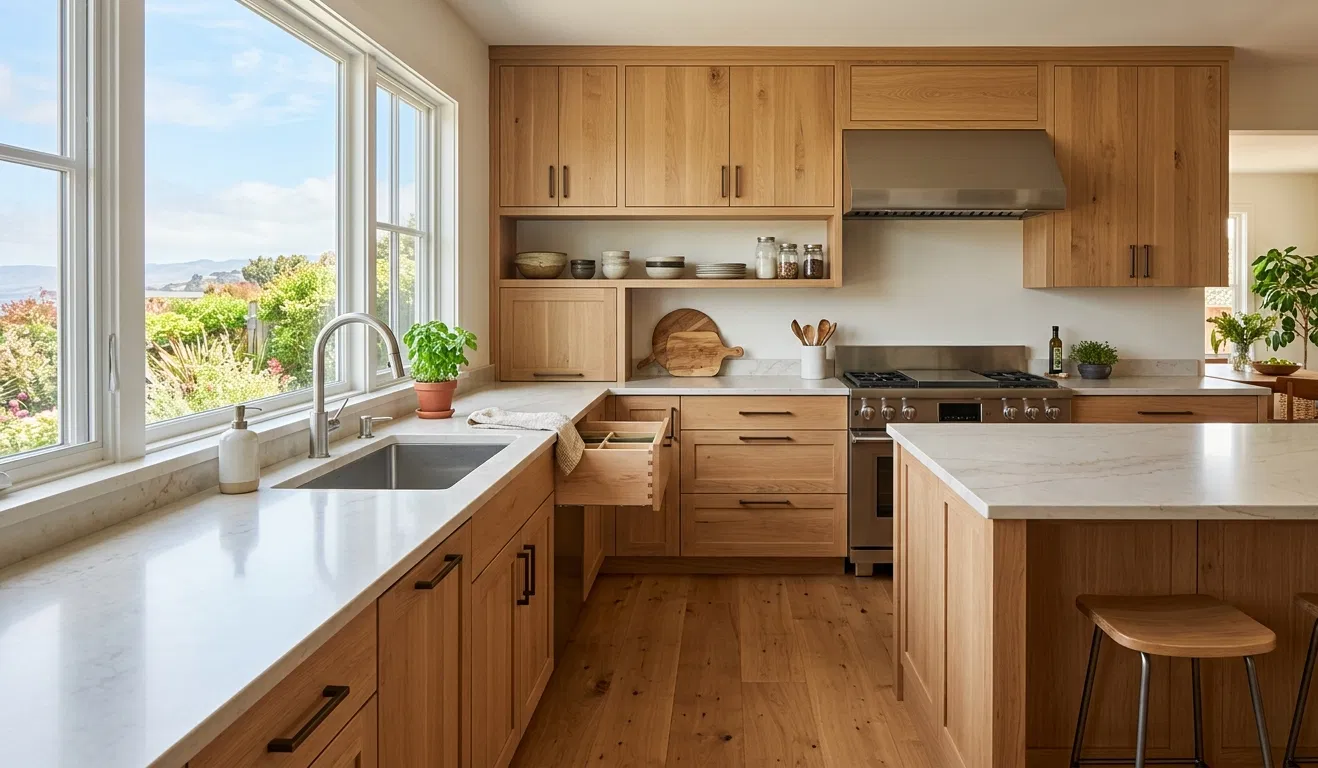

Full overlay doors sit in front of the cabinet box and cover most of the frame, giving a clean modern look at a lower cost. Inset cabinets sit flush inside the face frame like furniture, leaving the frame lines visible; each door is fitted to its own opening, so they cost more.
Inset cabinets vs full overlay: the quick comparison
One useful distinction: inset and full overlay describe where the door sits, while frameless describes how the cabinet box is built. Frameless cabinets generally use full overlay doors because there is no face frame for a door to sit inside.
| Inset | Full overlay | Frameless | |
|---|---|---|---|
| How the door sits | Flush inside a face-frame opening | Covers most of the face frame | Covers the front edge of a frameless box |
| Look | Visible frame lines; furniture-like | Broad, clean door fronts | Minimal gaps and uninterrupted fronts |
| Cost ballpark | Estimate: commonly 15–30% more than comparable full overlay | Baseline for comparison | Often similar to full overlay; depends on box and hardware |
| Precision required | Very high; each door is fitted to its opening | More forgiving of small alignment variations | Accurate box and door alignment still matters |
| Space efficiency | Face frame narrows the clear opening | More opening access than inset on a face-frame cabinet | Can gain roughly 1–1.5 inches of usable interior width per cabinet compared with face-frame construction; actual gain varies |
| Best for | Traditional, Shaker, English, or furniture-style kitchens | Modern and transitional kitchens | Contemporary kitchens and compact spaces |
| Care over time | Keep reveals even; seasonal movement may call for hinge adjustment | Small changes are less noticeable | Keep door gaps aligned and hardware adjusted |
Cost and usable-space comparisons are planning guidelines, not specifications or quotes. Cabinet dimensions, materials, and hardware affect the final result.

How the doors and boxes are built
Inset cabinetry uses a face frame attached to the front of the cabinet box. The doors and drawer fronts sit within the frame’s openings. A consistent reveal, the narrow clearance around each front, is essential. A typical target is about 1/8 inch, with some designs using roughly 1/8 to 3/16 inch depending on the door, hardware, and construction.
That small gap takes careful planning. Hinges need to be adjustable, and each opening and front must be measured and fitted accurately. Solid wood also moves across its grain as indoor humidity changes through the seasons. With an inset door, a small amount of expansion or shrinkage can make the gap uneven or cause a door to rub, so the maker has to account for wood movement and set the reveal with care.
Full overlay doors cover most of a face frame, making small differences in the frame or wall less visible. Frameless cabinets skip the face frame altogether: doors attach to the sides of the box, leaving more of the box opening clear. Cabinet boxes are commonly built from 5/8- to 3/4-inch plywood, depending on the design and specifications.

What inset costs, and why
As a broad estimate, inset cabinetry commonly costs 15–30% more than comparable full overlay. This is a relative planning range, not a fixed price. The difference usually comes from additional machining, hand-fitting, hinge adjustment, and the time needed to keep every reveal consistent.
Inset makes alignment easy to see. If a wall or cabinet box is out of square, the reveal can look uneven from one end of a door to the other. Full overlay hides more of those small variations, so it can be a more forgiving option in an older home. In either style, the final estimate depends on the room, cabinet quantity, materials, finish, and design details.
For a broader Bay Area budgeting overview, see our guide to custom cabinetry costs. If you’re weighing custom work against ready-made options, our post on custom cabinets vs. big box store cabinets can help you compare what goes into each choice.
Which style fits your kitchen?
Start with the look you want, then consider the room and how much clear storage space you need.
- Modern or contemporary: Full overlay or frameless fronts suit simple lines and broad, uninterrupted surfaces.
- Traditional, Shaker, English, or furniture-style: Inset can make the cabinetry feel more like built-in furniture, with frame lines that add detail.
- Small kitchen, ADU, or townhome: Frameless construction can provide more usable interior width, which may help when storage is tight.
- Older Bay Area home with out-of-square walls: Full overlay is generally more forgiving when small alignment differences are present.
Local architecture can help guide the choice, too. Eichler and other mid-century homes in Palo Alto and San Jose often pair well with full overlay or slab fronts. In Los Gatos, Saratoga, Atherton, and Hillsborough, traditional and estate-style interiors may call for inset detailing. These are starting points, not rules; the right choice depends on the home and your preferences.
Alfa Woodworks LLC is a custom cabinet maker serving San Jose, Santa Clara and the greater Bay Area. Explore our custom kitchen cabinets or learn more about working with a custom cabinet maker.
What we’d do for a Bay Area kitchen
We’d first look at the room’s architecture, wall conditions, and storage needs. For a compact ADU or townhome where every inch matters, we’d compare frameless construction with full overlay. For a traditional kitchen where visible frame lines are part of the design, inset may be worth the added fitting work and estimated cost.
At Alfa Woodworks, we build four cabinet styles in-house and can show you real samples before you commit. We create 3D renderings before anything is built, so you can review the door lines in your own room. Our production typically takes 3–4 weeks, compared with the 4–8 weeks common elsewhere; actual timing depends on the project and materials. Soft-close hinges are standard on every style, and we share photo updates as the project progresses.
Frequently asked questions
Is inset more expensive than full overlay?
As a planning estimate, inset commonly runs 15–30% more than comparable full overlay because it takes more fitting and adjustment. The exact difference depends on the design, materials, and project scope.
What is the difference between inset and full overlay cabinets?
Inset doors sit inside a face-frame opening, with the frame visible around them. Full overlay doors sit in front of the frame and cover most of it, creating a broader front and hiding more small alignment variations.
Do inset cabinets waste space?
Inset cabinets use a face frame, which reduces the clear opening compared with frameless construction. The exact difference depends on cabinet dimensions and design. Frameless cabinets can gain roughly 1–1.5 inches of usable interior width per cabinet, though the actual gain varies.
Are inset cabinets worth it?
They may be worth the extra cost if you like the furniture-style look and value consistent frame lines. If budget, a more forgiving fit, or maximum usable interior space matters more, full overlay or frameless may be a better match.
Can you mix inset and full overlay?
Yes, but plan the combination carefully. Using different styles in separate areas can work when the transition feels intentional, for example, a distinctive island paired with simpler surrounding cabinetry. Samples and a 3D rendering can help you judge how the door lines will look together.
Which is better for a small kitchen?
Frameless cabinets are often a practical choice when interior width is a priority. Full overlay is another option if you want a clean look with face-frame construction. Compare actual cabinet dimensions and storage needs before deciding.
If you’re comparing cabinet styles for a kitchen in San Jose, Santa Clara, or the greater Bay Area, book a free consultation with Alfa Woodworks. Call (408) 818-9500 to talk through your space, samples, and design options.